

Restaking platforms are supercharging middleware protocols like oracles, bridges, and data availability layers by letting staked assets secure multiple networks at once. This boosts yields and slashes security costs for DeFi builders. Today, we're diving into a restaking platforms comparison of the top three: EigenLayer, Symbiotic, and Karak. These powerhouses lead in middleware restaking analysis, especially for oracle bridge DA restaking and protocol monetization platforms. With EigenLayer's massive TVL edge, Symbiotic's flexibility, and Karak's cross-chain vibe, picking the right one can swing your middleware project's economics.
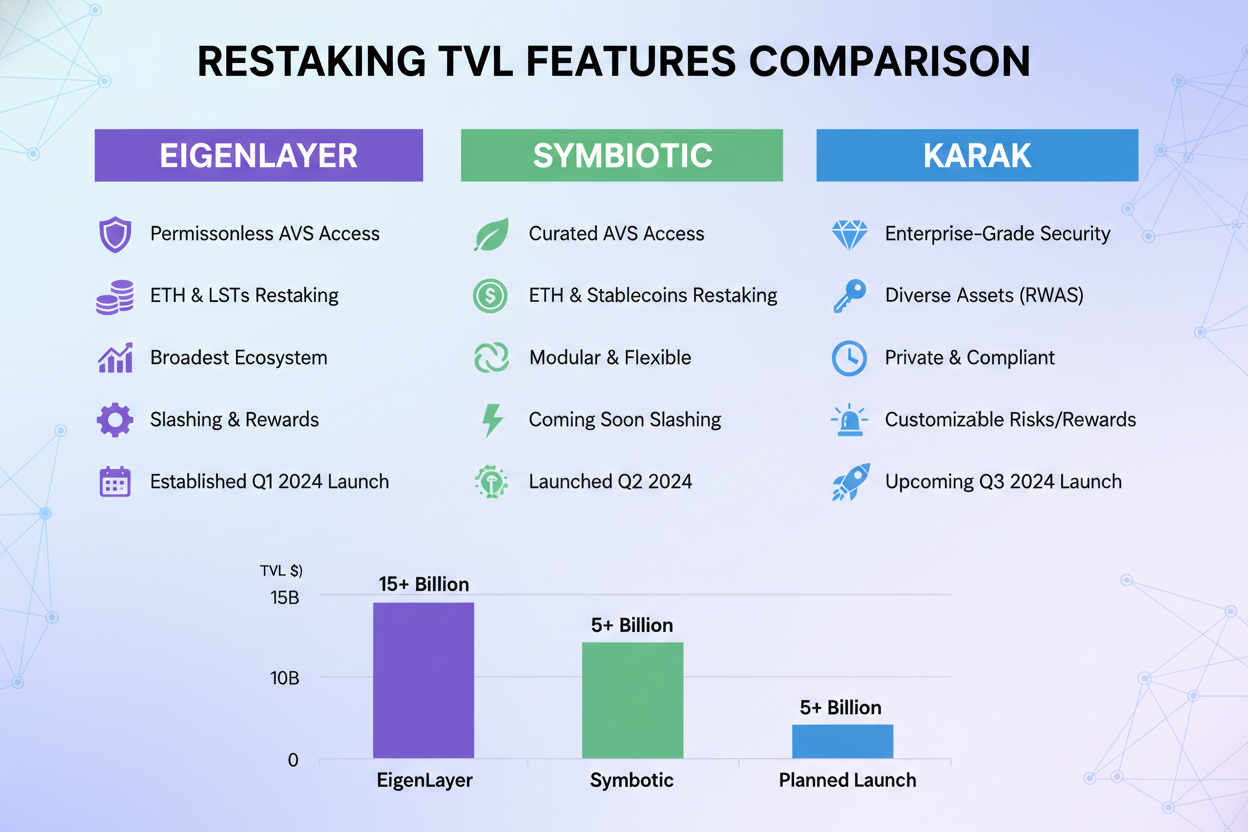
EigenLayer kicked off the restaking revolution, and it's still the benchmark. Boasting over $15 billion in TVL, it lets users restake staked ETH to back middleware services. Think oracles like UMA or Tellor; they tap EigenLayer's Ethereum-grade security without bootstrapping from scratch. As a swing trader eyeing oracle restaking momentum, I love how protocol upgrades here trigger price action in LSTs. Developers get capital efficiency, restakers snag extra yields, and everyone wins on slashed fragmentation risks.
EigenLayer: The Heavyweight Champion for Secure Middleware Scaling
EigenLayer's dominance isn't hype. It pools ETH stakes to secure AVSs (Actively Validated Services), perfect for bridges needing robust slashing mechanisms. Current TVL sits at $15.5 billion, dwarfing competitors. For DA layers, this means cheaper, shared security. Practical tip: If your oracle protocol launches an AVS integration, watch for TVL inflows; they've historically pumped related tokens 20-50% on announcement. But it's ETH-centric, so liquidity whales rule the roost.
Symbiotic: Permissionless Power for Multi-Asset Oracle Plays
Symbiotic flips the script with its modular, permissionless design supporting any ERC-20 token. TVL around $1.4 billion, but that's gold for medium-sized investors chasing EigenLayer vs Symbiotic edges. Vaults automate delegations, ideal for bridge operators stacking yields across assets. Backed by Paradigm, it's integrated with Lido, making it a no-brainer for oracle restaking where Tellor-style momentum meets diverse collateral. Non-upgradeable contracts scream decentralization, reducing rug risks. Swing traders, note: Lower TVL means outsized pumps on adoption news.
Karak rounds out the trio with multi-asset restaking and cross-blockchain compatibility. Hitting $1 billion TVL, it's closed to new deposits right now, creating scarcity FOMO. Services define duties and rewards, while operators run the nodes. For DA protocols eyeing non-Eth chains, Karak's universal collateral model diversifies beyond ETH. Bridges love the cross-chain angle; it future-proofs monetization. From my trading lens, Karak's asset flexibility sparks wild swings when L2s integrate.
Karak Network: Cross-Chain Catalyst for Bridge and DA Monetization
Karak stands out by accepting varied assets, letting middleware tap validators across ecosystems. No ETH monopoly here; restake BTC derivatives or stables for oracle duties. This cross-chain compatibility is practical rocket fuel for global bridges. TVL growth to $1 billion signals operator momentum. Heads up for protocol monetization: Karak's reward structures let DA layers customize emissions, juicing TVL velocity. If you're building, prioritize operator diversity to mitigate centralization drags.
Stacking these platforms head-to-head reveals battle lines. EigenLayer leads TVL for sheer scale, Symbiotic wins flexibility for creative oracle strategies, and Karak owns cross-chain for ambitious bridges. Risks? EigenLayer's concentration amps correlation crashes, Symbiotic's modularity invites operator fragmentation, Karak's novelty carries execution beta. For oracle bridge DA restaking, blend them: Core security on EigenLayer, yields on Symbiotic, expansion via Karak.
Blending these platforms isn't just theory; it's a battle-tested playbook for protocol monetization platforms. EigenLayer anchors your oracle's core security, Symbiotic layers on diversified yields, and Karak flings open cross-chain doors for DA expansion. But let's drill into the gritty details that separate winners from also-rans in middleware restaking analysis.
Risk Breakdown: Where Each Platform Shines and Slips
EigenLayer's $15.5 billion TVL fortress comes with a catch: ETH concentration. If Ethereum stumbles, your middleware feels the quake first. Slashing works great for oracles spotting bad data, but operator centralization lingers as a drag. Symbiotic sidesteps this with ERC-20 freedom, slashing risks across vaults tailored for bridge collateral. Its $1.4 billion TVL means less crowded trades, but watch for vault mismatches in volatile markets. Karak's $1 billion TVL and multi-asset play diversify beautifully for DA layers, yet cross-chain ops amp smart contract bugs. Practical move: Stress-test your middleware duties on testnets matching each platform's slashing logic.
From my eight years swinging crypto tides, oracle restaking shines brightest here. UMA and Tellor thrive on EigenLayer's scale for dispute resolution security, but Symbiotic's vaults let you stack non-ETH reporters for juicier APYs. Karak? Perfect for Tellor eyeing L2 bridges. Recent protocol upgrades, like Karak's operator expansions, have sparked 30% token pops; time entries off TVL deltas, not hype.
Middleware Fit: Oracles, Bridges, and DA Tailored Breakdown
Oracles demand precision slashing. EigenLayer's AVS framework nails it, powering UMA's optimistic verifiers with Ethereum proofs. Symbiotic edges for medium-scale oracles via customizable vaults, dodging EigenLayer's whale dominance. Karak adds cross-chain feeds, letting oracles pull DA from Cosmos without bridges.
Bridges crave interoperability. Karak leads with native multi-chain validators, securing light clients across ecosystems. Symbiotic's ERC-20 support automates relayer stakes, while EigenLayer fortifies Ethereum-centric spans like Optimism portals. Monetization hack: Emit bridge fees as restaking rewards to bootstrap TVL.
DA layers scale or die. EigenLayer shares Ethereum DA cheaply, Symbiotic composes with Lido LSTs for yield boosts, and Karak universalizes it beyond ETH for Solana-style speed. Builders, prioritize Karak for non-EVM chains; its $1 billion TVL scarcity builds FOMO fast.
Monetization mechanics vary sharply. EigenLayer's points system gamifies early AVS adoption, funneling billions into middleware yields. Symbiotic's vaults enable dynamic reward curation, perfect for oracle token buybacks. Karak's duty-reward marketplace lets DA protocols auction security, capturing premium fees. Stack yields: Restake oracle rewards into Symbiotic for 2x looping, then Karak for cross-chain alpha. TVL multipliers here beat vanilla staking by 15-25% in bull legs.
Trader's Edge: Momentum Plays in Restaking Wars
As a Tellor swing specialist, I track restaking flows like hawks eye mice. EigenLayer TVL spikes signal LST pumps; Symbiotic integrations ignite mid-caps. Karak's closed deposits? Pure squeeze play, reopened phases crush shorts. EigenLayer vs Symbiotic boils to scale vs agility: Go Eigen for blue-chip oracles, Symbiotic for nimble bridges. Crossovers, like Symbiotic's Lido tie-ins, print when middleware announces. Risk-manage with 1: 3 setups off TVL charts; exits on dilution flags.
Future-proof your stack by hybridizing. Core oracle duties on EigenLayer's bedrock, experimental bridges via Karak's frontier, yield-optimized DA on Symbiotic. This trio maximizes oracle bridge DA restaking economics, turning security costs into revenue engines. DeFi builders and yield chasers, test these waters now; the middleware tide waits for no one. Swing smart, monetize harder.



No comments yet. Be the first to share your thoughts!