Reputation Oracles for Oracle Restaking: Maximizing Yields and Security in DeFi 2026

As DeFi matures into 2026, the fragility of oracle networks stands out amid the clamor for higher yields. I’ve watched cycles of hype and correction over two decades, and one truth persists: security underpins sustainable returns. Reputation oracles, layered into restaking protocols, offer a measured path to fortify data integrity without chasing fleeting pumps. These systems score data providers on historical accuracy, uptime, and resistance to manipulation, channeling restaked capital toward reliable operators while slashing the unreliable.

Why Reputation Oracles Matter in Oracle Restaking
Traditional oracles falter when off-chain data skews on-chain decisions, as seen in past liquidations from faulty feeds. Reputation oracles counter this by assigning dynamic scores, akin to credit ratings in macro finance, that influence staking rewards and penalties. In restaking setups like EigenLayer’s AVS or Symbiotic’s ERC-20 pools, these scores dictate collateral allocation, prioritizing operators with proven track records. This isn’t mere gamification; it’s a macro hedge against systemic oracle risk, ensuring yields from oracle restaking yields 2026 remain stable across market volatility.
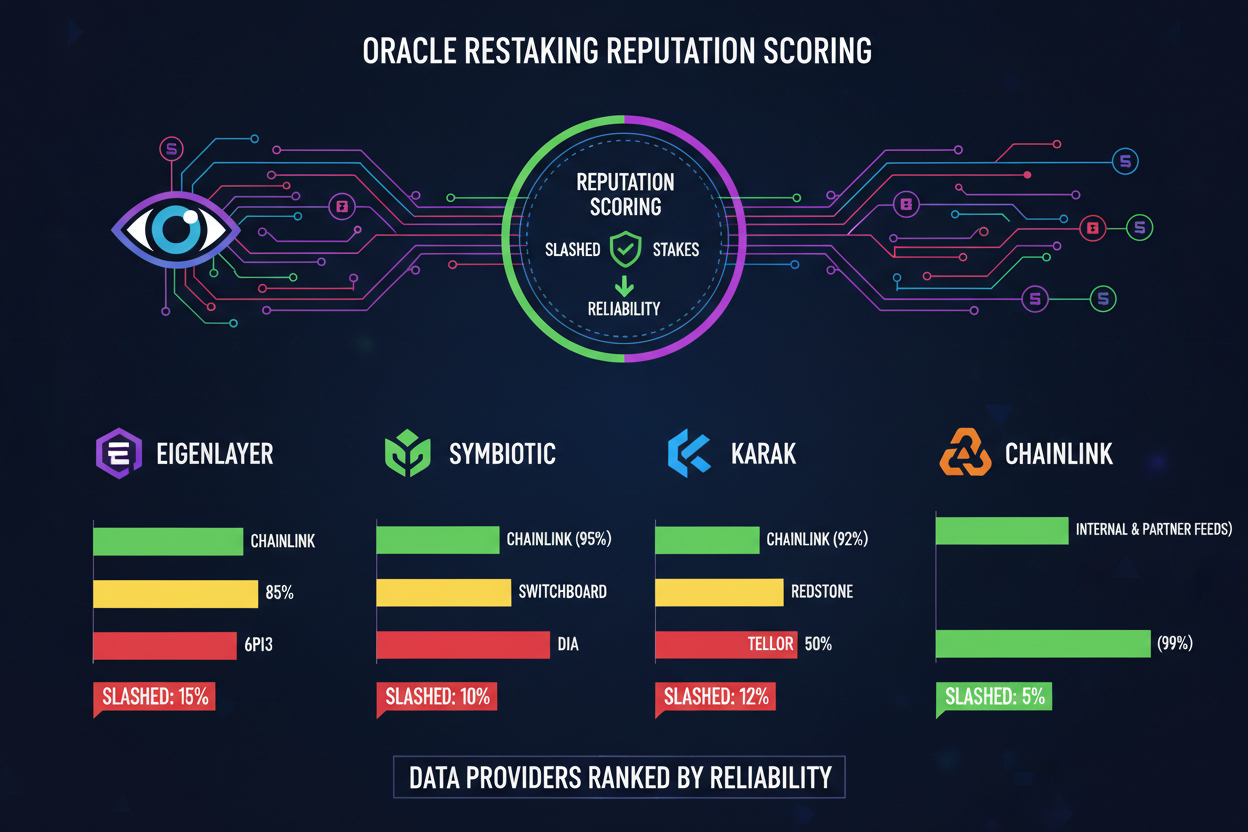
Reflecting on middleware monetization oracles, projects like RedStone’s EigenLayer integration exemplify this. With Ether. fi’s $500 million commitment across 20,000 nodes, reputation metrics now underpin AVS security, mitigating liveness failures. Similarly, Karak Network’s pools delegate LSTs to vetted operators, enhancing uptime for real-world data feeds.
Top Platforms Driving Reputation-Enhanced Restaking
Among the top 12 DeFi staking platforms pivotal to oracle restaking, each brings unique reputation mechanisms. EigenLayer leads with AVS slashing tied to validator performance, while Chainlink Staking enforces node reputation via stake delegation. Lido Finance and Rocket Pool provide LSTs that feed into restaking, their liquid tokens scored for liquidity and audit rigor. Symbiotic stands out for permissionless ERC-20 collateral, enforcing granular slashing only on proven misbehavior. Karak Network specializes in oracle operator pools, Ether. fi powers liquid restaking with eETH for AVSs, and Renzo Protocol optimizes yields through reputation-vetted nodes.
Puffer Finance and Kelp DAO extend this with modular restaking, where reputation influences pool allocations. StakeWise offers solo staking with reputation dashboards, and Tellor integrates decentralized reporting with stake-weighted reputation, directly bolstering oracle restaking security DeFi. These platforms, audited rigorously with varied unbonding times, form the backbone for developers seeking middleware resilience.

Balancing Yields with Slashing Protection
In my view, restaking reputation mechanisms shine brightest when they prioritize slashing protection over aggressive APYs. Lagrange’s ZK-proof oracles bind data to restaked collateral, verifiable tamper-proof, ideal for derivatives. Yet, amplified risks loom in multi-AVS setups; a single oracle compromise cascades penalties across shared stakes. Platforms like those listed mitigate this through hybrid models, blending decentralized oracles with institutional-grade verification, echoing TraderMade’s hybrid advocacy. This reflective layering fosters enduring infrastructure, not short-term speculation.
By delegating to high-reputation pools in Ether. fi or Karak, stakers capture compounded yields while insulated from data integrity threats. Puffer Finance’s node selection and Renzo’s risk-adjusted metrics further exemplify this prudence, ensuring DeFi’s oracle layer withstands 2026’s scale.
Over cycles, I’ve learned that true middleware monetization oracles emerge from deliberate risk calibration, not yield chasing. Platforms like StakeWise and Tellor embody this, with StakeWise’s reputation dashboards enabling solo stakers to monitor operator performance in real-time, and Tellor’s stake-weighted reporting punishing inaccuracies through direct slashing. These features align restaking incentives with long-term data fidelity, crucial as DeFi absorbs real-world assets.
Navigating Systemic Risks in Reputation Restaking
Systemic vulnerabilities persist despite these advances. Multi-AVS correlations amplify slashing events, where one oracle lapse triggers widespread penalties. Cryptollia’s analysis highlights this interconnected peril, urging diversified collateral in Symbiotic or Karak. Reputation oracles mitigate by gating low-score operators from high-value pools, yet demand vigilant monitoring. In 2026’s scaled DeFi, hybrid oracles blending Chainlink’s decentralization with institutional feeds, as TraderMade suggests, fortify against such threats.
Consider Lido Finance and Rocket Pool’s LSTs: their deep liquidity supports restaking without forced exits during volatility, but reputation layers added via integrations like Ether. fi ensure data-backed decisions. Puffer Finance’s modular nodes and Kelp DAO’s DAO-governed pools further distribute risk, rewarding operators with unblemished records. This ecosystem-wide prudence echoes my mantra: build for cycles.
Maximizing Oracle Restaking Yields Through Reputation
To capture oracle restaking yields 2026, stakers must weigh reputation against APY. EigenLayer’s AVS, bolstered by RedStone, offers baseline yields with reputation-upgraded security. Chainlink Staking delegates to high-repute nodes, yielding stability over speculation. Renzo Protocol’s node curation and Ether. fi’s eETH liquidity compound returns prudently, often 15-25% APY ranges per Coin Bureau’s 2026 rankings, contingent on operator scores.
Yet yields alone mislead. Tellor’s decentralized reporters, integrated into restaking, prioritize accuracy, slashing manipulators to protect principal. StakeWise’s flexibility suits conservative allocators, while Symbiotic’s ERC-20 freedom invites cross-chain reputation portability. These dynamics foster restaking reputation mechanisms that endure bear markets, unlike hype-driven alternatives.
Developers building on these platforms gain from granular slashing: Karak’s pools demand proof-of-misbehavior, Lagrange’s ZK binds outputs to stakes. This elevates oracle restaking security DeFi, enabling compliant, multi-billion protocols as CimCo Tech notes. Reflection reveals a maturing paradigm, where reputation oracles transform middleware from vulnerability to value generator.
Investors and builders alike should audit TVL tiers, unbonding periods, and restaking options across the top 12. High TVL in EigenLayer or Lido signals resilience; short unbonding in Rocket Pool aids liquidity. Layered with reputation, these form DeFi’s enduring spine, securing yields through proven integrity rather than promises.