
Map your integration value chain
Before setting a price, you must identify where your middleware sits in the data flow and which layer consumes the value. This mapping establishes the basis for your pricing strategy by clarifying who benefits most from your integration.
Start by tracing the data from its source to the final consumer. Identify the specific pain points your middleware solves at each stage—whether it is reducing latency, ensuring compliance, or transforming formats. The layer that faces the highest operational cost or regulatory risk typically holds the most willingness to pay.
Next, define the revenue model based on this position. If your middleware acts as a critical bridge between high-value data sources and enterprise applications, a usage-based or tiered model often captures more value than a flat fee. This approach aligns your costs with the customer's perceived gain, ensuring sustainable margins as volume scales.
Finally, audit your current architecture to spot leakage. Ensure that no intermediate steps add unnecessary cost without adding visible value to the buyer. A clear map reveals where to place the paywall for maximum conversion and minimal friction.
Choose your API gateway revenue model
Selecting the right billing structure is the first step in aligning your middleware API with developer consumption patterns. In 2026, the API economy has shifted entirely toward direct API revenue, moving beyond simple access fees to value-based pricing. Your choice of model determines how predictable your cash flow is and how easily you can scale as usage grows.
Three primary models dominate the market: subscription, usage-based, and hybrid. Each serves different developer behaviors and business goals. Use the comparison below to see how they stack up against predictability, scalability, and implementation complexity.
| Model | Revenue Predictability | Scalability | Billing Complexity |
|---|---|---|---|
| Subscription | High | Low | Low |
| Usage-Based | Low | High | High |
| Hybrid | Medium | Medium | Medium |
Subscription (Tiered)
Subscription models charge a flat monthly or annual fee for access to specific API tiers. This approach offers high revenue predictability, making it ideal for stable, recurring cash flow. However, it limits scalability because revenue caps at the subscription price regardless of how much data or compute the developer consumes. Implementation is straightforward, often requiring only simple access control lists.
Usage-Based
Usage-based billing charges developers per request, per GB of data, or per compute unit. This model scales effortlessly with developer success, ensuring you capture value from heavy users. The trade-off is lower revenue predictability and higher billing complexity, as you must track every micro-transaction accurately. It works best for APIs with variable consumption patterns, such as AI inference or real-time data feeds.
Hybrid
Hybrid models combine a base subscription fee with overage charges for usage beyond included limits. This balances predictability with scalability, offering a "floor" of recurring revenue while allowing upside potential. It is moderately complex to implement, requiring robust metering and billing infrastructure to handle tiered thresholds.
Decision Checklist
Use this checklist to validate your choice before finalizing your gateway configuration:
-
Does the model align with how developers actually consume your API?
-
Can your billing infrastructure handle the required metering granularity?
-
Is there a clear path to upselling or tier upgrades?
-
Have you tested the pricing structure with a small group of beta users?
Implement usage-based billing infrastructure
Setting up usage-based billing requires configuring your API gateway to track calls accurately and trigger billing events in real time. This infrastructure ensures you only charge for actual consumption, which is the foundation of middleware monetization.
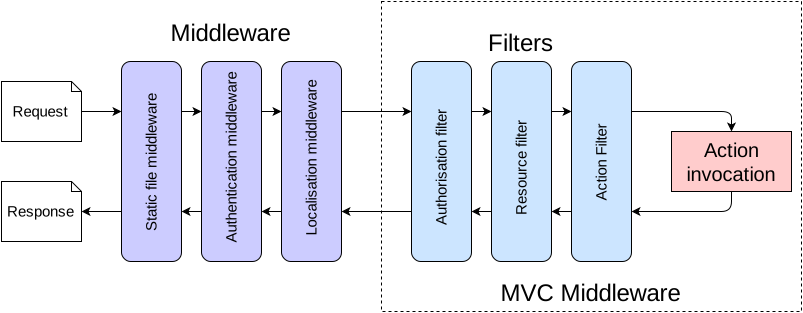
Start by defining usage tiers in your API gateway. Most modern gateways support per-second or per-request metering. Enable request counting middleware that logs unique API keys or tenant IDs. This data forms the basis for your usage reports and ensures accurate tracking of each consumer's activity.
Connect your gateway to a billing platform like Stripe Billing or Chargebee. These services handle complex pricing logic, including tiered rates and overage charges. Create a webhook listener in your backend to receive usage events from the gateway. Map these events to specific price books in your billing provider to automate invoice generation.
Implement token-based authentication to identify paying customers. When a user hits their usage limit, return a 429 Too Many Requests status code. Configure webhooks to notify your system when a payment fails or a subscription expires. This allows you to automatically revoke API access until the account is current, protecting your revenue stream.
Avoid common pricing mistakes
Pricing middleware isn't just about setting a number; it's about aligning that number with the actual cost of delivering data. Many developers treat middleware as a free utility, only to find their margins erased by infrastructure costs they didn't account for. To monetize effectively, you must separate your pricing signals from your backend expenses.
Underpricing data freshness
If your API returns real-time market data, charging a flat fee for "daily updates" creates a mismatch. Users will expect live feeds, but you're only delivering batched data. This leads to support tickets and churn. Conversely, if you charge for real-time data but deliver it with a 15-minute delay, you're misrepresenting the product.
Audit your SLA (Service Level Agreement) carefully. If you offer sub-second latency, your pricing tier must reflect the infrastructure cost of maintaining that speed. Don't bundle high-frequency data into low-cost entry tiers. Instead, create distinct tiers: one for historical batch data (cheap) and one for live streaming (premium). This clarity protects your revenue and sets accurate user expectations.
Ignoring network fees and egress costs
Middleware sits in the middle. Every request triggers data movement. If you don't factor in cloud egress fees, API gateway costs, or third-party data provider fees, your "profit" is an illusion. A common mistake is capping usage without accounting for the variable cost of each call.
Calculate your "landed cost" per API call. Include the base server cost, the data provider fee, and the network egress charge. If your landed cost is $0.001 per call, you cannot charge $0.0005 and expect to survive. Use this calculation to set your minimum viable price. Any price above that is your margin. Never let volume discounts erode below your landed cost.
Failing to adjust for volume tiers
Static pricing works for simple tools, but middleware scales. A startup making 10,000 calls a month has different needs than an enterprise making 10 million. If you offer only one price, you leave money on the table from heavy users and price out light users.
Implement volume-based tiers. Start with a low entry point for testing, then scale the price per unit down as volume increases, but never below your landed cost. This encourages growth while protecting margins. Make sure your billing system can handle these transitions automatically so you don't have to manually invoice or adjust limits.
List your API on B2B marketplaces
Distributing your middleware through established B2B developer marketplaces accelerates adoption by placing your API directly in front of buyers who are already searching for integrations. Instead of building a customer base from zero, you leverage existing platforms that handle discovery, trust, and often initial billing.
Choose the Right Marketplace
Not all directories serve the same audience. Technical marketplaces like RapidAPI cater to developers looking for quick, copy-paste solutions, while enterprise-focused directories like AWS Marketplace or Azure Marketplace target procurement teams with stricter security and compliance requirements. Align your choice with your target buyer’s purchasing journey.
Prepare Your API for Listing
Marketplaces require more than just an endpoint. You need clear documentation, standardized pricing tiers, and robust access controls. Most platforms require you to configure billing and access controls before approval. Ensure your API gateway revenue model is clearly defined and that your documentation explains the integration value chain simply.
Optimize Your Listing
Treat your marketplace listing like a product page. Use precise keywords, provide code samples, and highlight unique middleware capabilities. A well-optimized listing reduces friction for developers evaluating your solution, turning passive visitors into active subscribers.
FAQ about middleware monetization
How to monetize middleware in 2026?
The 2026 API economy has shifted entirely toward API Revenue models. Instead of relying on one-time sales, developers now monetize Large Language Models (LLMs) and premium data streams through recurring structures. The most effective approach combines usage-based billing with tiered access, ensuring that revenue scales directly with the value your middleware delivers to downstream applications.
What are the primary software monetization models?
Teams generally adopt three core models for 2026. Flat-rate subscription monetization provides predictable recurring revenue for stable workloads. Per-seat monetization aligns costs with user adoption, ideal for internal tools. Usage-based monetization charges strictly for API calls or data processed, which is often the preferred method for external-facing middleware APIs where demand fluctuates.
What is a monetization framework?
A monetization framework is the technical and business infrastructure that tracks, measures, and bills API consumption. It includes rate limiting, quota management, and billing integration. Without this framework, you cannot accurately attribute revenue to specific API endpoints or enforce the pricing tiers necessary for sustainable middleware monetization.
What is the best monetization method for APIs?
There is no single best method, but usage-based pricing is currently the industry standard for middleware. It aligns your incentives with the customer's success. If your middleware helps a client process more data or serve more users, your revenue grows proportionally. This method reduces friction for adoption while protecting your margins during high-volume periods.
No comments yet. Be the first to share your thoughts!