
Choose your billing model
Your middleware’s revenue strategy depends on how you charge for access. The three standard approaches are usage-based, tiered, and hybrid models. Each model carries different trade-offs for developer friction, cost predictability, and revenue scalability.
Usage-based billing charges clients for actual API consumption, such as the number of requests or data rows processed. This model aligns costs with value, making it ideal for oracle and data aggregator services where demand fluctuates. However, it introduces cost unpredictability for enterprise clients who may face surprise bills during traffic spikes.
Tiered billing offers fixed pricing for specific usage caps or feature sets (e.g., Basic, Pro, Enterprise). This approach provides high cost predictability for buyers and simplifies budgeting for your clients. It works well for bridge infrastructure where stable, recurring revenue is prioritized over variable per-call fees. The trade-off is higher developer friction, as you must manage complex subscription logic and plan upgrades.
A hybrid model combines both approaches, charging a monthly subscription fee plus overage charges for usage beyond the tier limit. This is often the most robust strategy for middleware in 2026, balancing predictable baseline revenue with the ability to scale as clients grow.
| Model | Cost Predictability | Dev Friction | Revenue Scalability |
|---|---|---|---|
| Usage-Based | Low | Low | High |
| Tiered | High | High | Medium |
| Hybrid | Medium | Medium | High |
When selecting a model, consider your specific middleware type. Oracle networks typically thrive on usage-based models because data demand is direct and variable. Bridge protocols often prefer tiered or hybrid models to ensure consistent operational coverage for node operators. Data aggregators can leverage hybrid models to capture value from both high-volume institutional clients and smaller retail developers.
Connect the payment gateway to your middleware
To monetize API traffic, you must bridge your middleware layer with a billing provider like Stripe. This setup ensures that usage data flows from your API into a billing engine that can handle subscriptions, metering, and invoicing. The middleware acts as the central nervous system, capturing request metadata and forwarding it to the payment processor in real time.
Start by creating a Stripe account and generating API keys. You will need a publishable key for client-side interactions and a secret key for server-side operations. Store these credentials in your environment variables immediately. Never hardcode secret keys into your middleware source code, as this exposes your billing infrastructure to security risks.
1. Create a Stripe Customer and Subscription
When a user signs up for your API service, your middleware should create a corresponding Stripe Customer. This entity holds the payment method details and subscription status. Pass the user's unique identifier from your database to Stripe to ensure the customer record maps correctly to your internal user base.
Next, assign the user to a pricing plan. Stripe uses Products and Prices to define tiers. Your middleware should reference these Price IDs when creating the subscription. This allows you to switch users between plans without changing the underlying code logic. If the subscription creation fails, log the error and return a 402 Payment Required response to the client.
2. Configure Metered Billing for Usage
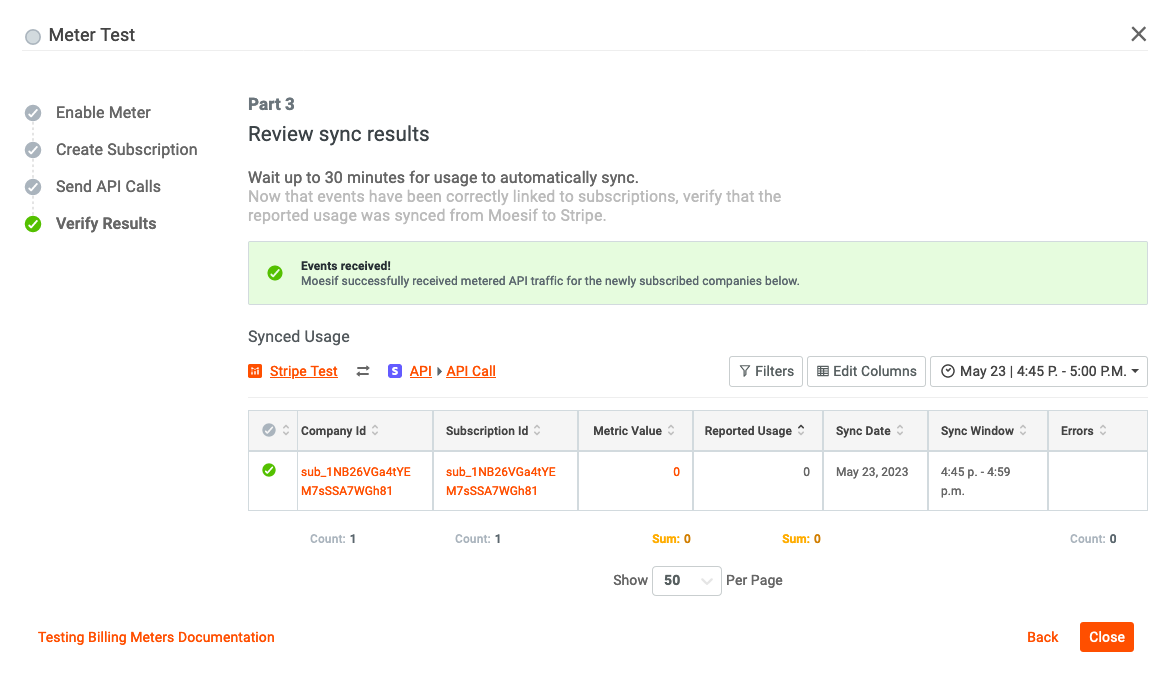
Most API services charge based on usage rather than a flat fee. Stripe Meters allow you to aggregate usage events over a billing period. Instead of charging per request, you sum up events like "API calls" or "data processed" at the end of the month.
In the Stripe Dashboard, create a new Meter for each billable metric. Note the meter ID, as your middleware will need it to report usage. Ensure the aggregation type matches your billing logic, such as summing total requests or counting unique active users.
3. Report Usage Events from Middleware
Your middleware must intercept API requests and report usage to Stripe. For every valid request, send a billing_meter_event to Stripe. Include the customer ID, the meter ID, and the quantity of usage (e.g., 1 request).
This step requires careful handling to avoid duplicate charges. Implement idempotency keys in your middleware to ensure that if a request is retried, the usage event is not counted twice. If the reporting fails, log the event locally and retry asynchronously. Do not block the API response while waiting for the billing server to confirm.
4. Handle Webhooks for Status Updates
Stripe communicates subscription changes, such as upgrades, downgrades, or cancellations, via webhooks. Your middleware must expose a webhook endpoint to receive these events. This endpoint should verify the Stripe signature to ensure the request is legitimate.
When a webhook event arrives, update your internal database to reflect the new subscription status. For example, if a user cancels, set their access level to "expired" and revoke API keys after the current billing period ends. This keeps your access control in sync with the billing provider without polling Stripe repeatedly.
5. Implement Usage Caching and Limits
To reduce latency, cache the user's subscription status and remaining quota in your middleware. Checking Stripe's API for every request adds significant overhead. Instead, store the status in Redis or an in-memory cache with a short TTL (Time To Live).
If the cache expires or a webhook indicates a change, refresh the status from Stripe. Use this cached data to enforce rate limits. If a user exceeds their plan's limit, your middleware should return a 429 Too Many Requests response immediately, preventing further usage until the next billing cycle or an upgrade.


Implement AI-driven analytics
Middleware monetization relies on turning raw usage data into pricing intelligence. By deploying AI models to analyze consumption patterns, you can move beyond static tiers into dynamic pricing that captures value from power users while protecting margins from abuse.
1. Analyze usage for dynamic pricing
AI models process historical usage metrics to identify elasticity curves for different customer segments. Instead of guessing price points, the system adjusts rates in real-time based on demand spikes and feature adoption. This allows you to capture maximum willingness to pay from enterprise clients without alienating smaller teams.
2. Detect fraud and abuse
Machine learning algorithms monitor API calls and transaction volumes to flag anomalous behavior. By establishing baselines for legitimate usage, the system identifies scraping, credential stuffing, or resource exhaustion attempts. Blocking these patterns before they scale prevents revenue leakage and keeps infrastructure costs predictable.
3. Plan capacity and costs
Predictive analytics forecast future resource needs based on current growth trajectories. This enables proactive scaling of server capacity, reducing the risk of downtime during traffic surges. Accurate capacity planning ensures you only pay for the infrastructure you actually need, directly improving net margins.
4. Validate model accuracy
Regularly audit AI pricing suggestions against actual conversion rates and churn data. If the model suggests prices that reduce adoption, recalibrate the training data. Continuous feedback loops ensure the analytics remain aligned with business goals and market conditions.
Validate revenue and compliance
Before going live, you must prove that your middleware monetization stack is auditable and compliant with financial regulations. This section ensures the system can handle real transactions without violating rules or confusing the end-user.
Audit the billing logic
Test the transaction flow end-to-end. Verify that taxes are calculated correctly for different regions and that currency conversions match live rates. Use a staging environment to simulate failed payments, refunds, and subscription cancellations. Ensure the middleware logs every step for dispute resolution.
Review legal requirements
Middleware often handles sensitive data or acts as a payment facilitator. Ensure your terms of service clearly define liability. If you are processing payments, verify compliance with PCI DSS standards. If you are handling user data, confirm adherence to GDPR or CCPA regulations. Consult a legal expert to review your data handling policies.
Ensure user transparency
Users must understand what they are paying for. Display clear pricing tiers before checkout. Avoid hidden fees that appear only at the final step. Provide a dashboard where users can view their usage history and current charges. Transparency builds trust and reduces churn.

Pre-launch checklist
-
Legal review completed for data and payment handling.
-
Billing accuracy tested with edge cases (refunds, failures).
-
Developer documentation audited for clarity and completeness.
-
User-facing pricing displayed without hidden fees.
-
Transaction logs verified for auditability.
Common billing: what to check next
Developers often ask how to handle the friction between metering usage and collecting payment. The goal is to keep your middleware stateless while ensuring every API call is accounted for. Here are the most frequent technical and business hurdles.
How does usage-based billing actually work?
Usage-based billing tracks specific actions—like API calls or data processed—and charges customers based on volume. You typically integrate a payment provider like Stripe to handle the metering and invoicing. As Zuplo notes, building this yourself requires writing middleware that talks directly to the payment API and caching subscription status to avoid redundant checks [src-2]. This approach gives you full control but demands rigorous error handling.
Should I bill per request or per data unit?
Choose the metric that aligns with your infrastructure costs. If your backend scales linearly with traffic, per-request billing is straightforward. If your costs are driven by compute or data egress, bill per megabyte or per million records. The key is transparency: clearly define what constitutes a "billable event" in your documentation to prevent disputes.
How do I handle billing disputes?
Disputes usually arise from unexpected spikes in usage. Implement a dashboard that shows real-time consumption and set up automated email alerts when a user hits 80% of their limit. This proactive communication reduces chargebacks and gives customers a chance to adjust their usage or upgrade their plan before the cycle ends.
No comments yet. Be the first to share your thoughts!